Archives: Spots

The Caves of Punta Rasa

Step into a world where sunlight dances with the sea. The Caves of Punta Rasa prove that some of the most magical dives happen in the shallows.

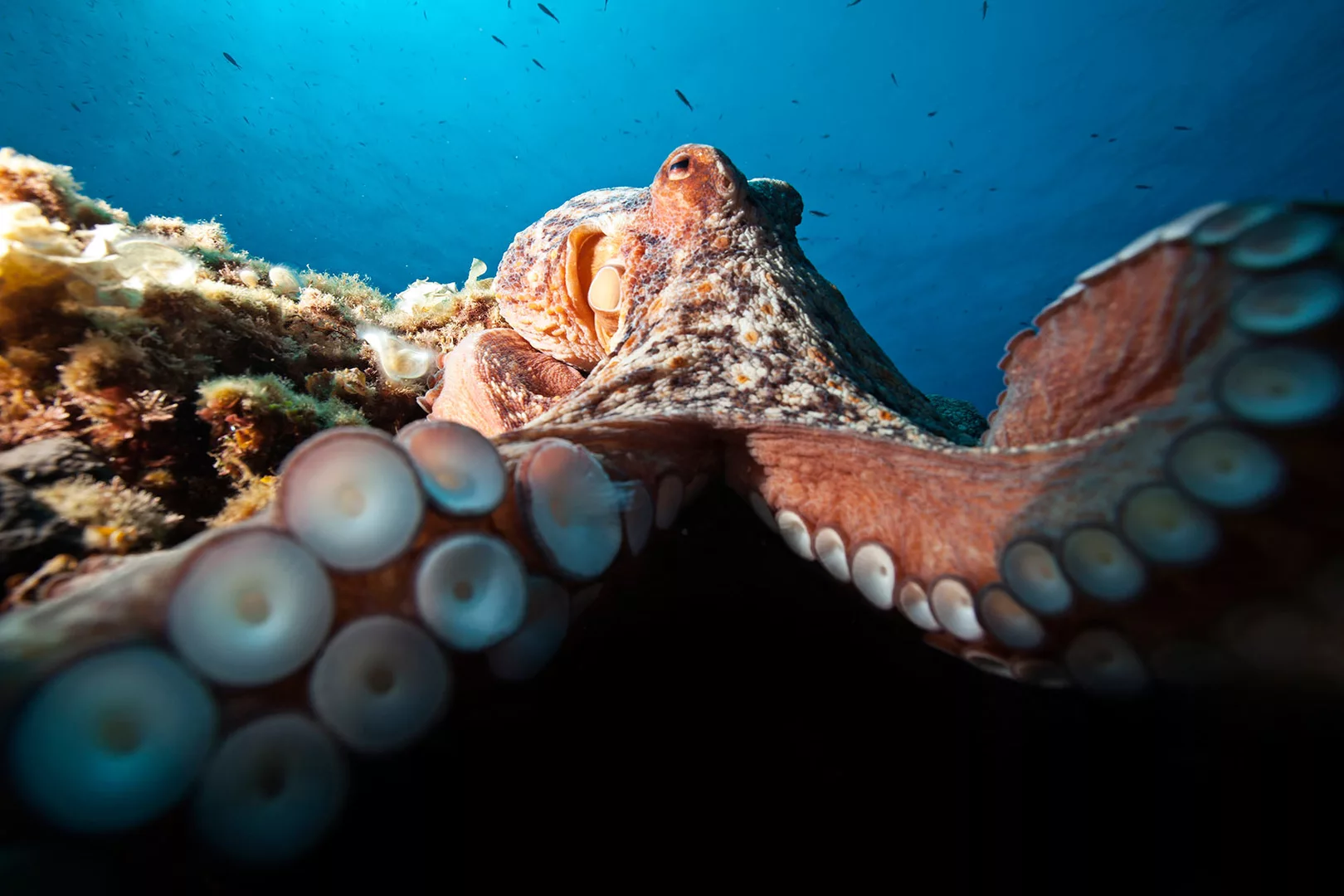
Nestled beneath towering cliffs, these spacious underwater caves welcome divers of all experience levels into a breathtaking natural cathedral. As you glide through the galleries, pockets of trapped air and shafts of sunlight create a mesmerizing display of blue and emerald reflections across the rocky walls. Every corner hides new life—curious octopuses, watchful moray eels, large groupers and schools of mullet share the caves with colourful crustaceans tucked into every crack. Calm, accessible and full of atmosphere, Punta Rasa is the kind of dive that reminds you the ocean’s greatest treasures aren’t always found in the deepest waters.

— Photos by Pedro Afonso

El Arco

Some dives show you marine life. Others make you feel like you’ve entered an underwater cathedral.
El Arco is where nature combines both.

As you descend onto the platform, the first thing that captures your attention is the landscape itself. Towering rock formations rise from the seabed, sculpted into magnificent natural arches that invite you to swim through them one by one. Sunlight filters across the stone, painting the reef with incredible colours while life seems to appear everywhere you look. Octopuses hide among the rocks, groupers patrol the arches, and nudibranchs, anemones and countless crustaceans decorate every crevice. Calm, welcoming and full of surprises, El Arco is the kind of dive that turns beginners into lifelong ocean lovers—and leaves photographers wanting just one more shot.

— Photos by Ana Ferreira and Eurico Roseiro

Plataforma Mariana

What was once built by people is now ruled by the sea.
At Plataforma Mariana, every beam has become a home for marine life.

As you descend toward the old metal structure resting off Espardell, it quickly becomes clear why this is one of Formentera’s most celebrated dives. Time has transformed the former fish farm into a thriving artificial reef, where curious barracudas cruise in schools, giant amberjacks patrol the blue, and groupers, moray eels, conger eels and lobsters shelter within the framework. Every level reveals something new, from perfectly camouflaged scorpionfish to colourful damselfish darting through the beams. Best suited for experienced divers, Plataforma Mariana offers an unforgettable blend of history, exploration and vibrant marine life—proof that nature always finds a way to reclaim its space.

— Photos by Ana Ferreira and Rolando Oliveira

Pozo de la Luna

A cave dive for experienced divers. After passing through a magnificent sheer wall, we arrive at the grand entrance at a depth of 13 meters to Moon Pool, one of the most famous caves in Menorca. A tunnel takes us through many curves of about 30 meters on the rocky coast of Cap d’En Font. Although we have seen these next tunnel, we swim over large pebbles with rounded edges until we reach a round room at the end. Here we make our safety stop, after which we surface and swim through a layer of fresh water. Now we are in a small room; the so-called Moon Pool. On the way back, we looked for “Billy” conger eel, crabs and shrimp, which we found here in large numbers.

— Spot description by Sonbouscuba

— Photos by Sonbouscuba

La Llosa del Patró Pere

La Llosa can be considered one of the best diving spots in the underwater reserve, with a resident group of about 200 barracudas. Here you can also spot large groupers and octopuses. Due to the depth (up to 25 meters where the barracudas are) and the possibility of strong currents, this is a dive site for experienced divers.

— Spot description by Sonbouscuba

— Photos by PADI

Junkers 88 Wreck

On 24 February 1943, this German Ju-88 A4 light bomber, stationed in Sicily, accidentally went off course after attacking targets in Algeria. Upon seeing the Isla del Aire Lighthouse and with little fuel available, the pilot decided to make an emergency landing at sea, in front of a trawler carrying local fishermen. All 4 crew members survived the landing. The plane now rests at a depth of 47 meters and that requires a Tec 50 certificate. We plan this dive on request, in collaboration with one of our partner dive centers.

— Spot description by Sonbouscuba

— Photos by Checkyeti

La Herradura

The horseshoe is best described as a tunnel with a 90 degree angle. We usually lie down in the Horseshoe as a shortcut on the way to the Moon Pond. After a wide opening, the tunnel quickly narrows and ends in a supposed chimney. Here, we swim a few meters and meanwhile look for shrimp and crayfish. After reaching the roof of the chimney, we also see the exit of the tunne

— Spot description by Sonbouscuba

— Photos by

Grand Grotto

Swimming along a steep wall, we reach the entrance to the Great Grotto, which starts at 16 meters and ends at 30. In the cave, we can choose, follow a tunnel to the left or continue straight. In any direction, we can go up. If diving both tunnels in a single dive, divers have to monitor their dive computer and make safety stops due to the numerous climbs.

— Spot description by Sonbouscuba

— Photos by

Els Fossils

Another attraction on the south coast of Menorca. At the end of a large overhang, about 13 meters deep, we find the three small openings that lead to this cave. This 30 meter long cave gets its name from the numerous fossils, which we can see on the ceiling. At the end of this cave there is a small bubble, where a layer of fresh water emerges through. A truly impressive dive. Unfortunately, only suitable for divers with a cave diving license, as the entrance/exit is not always visible.

— Spot description by Sonbouscuba

— Photos by

Caló Blanco

Anchor blocks placed here and there provide shelter for cuttlefish and octopuses. Here we can also find needlefish. The bottom of this bay is made up of rocks and sea grass on the sides, with white sand in the center. Since this bend is quite protected, we often have excellent visibility underwater.

— Spot description by Sonbouscuba

— Photos by Pedro Afonso

Diver´s Playground

Gigantic rocks and stones, combined with a steep wall, guarantee an unforgettable dive. Here we find tunnels, small caves and canyons everywhere. Here you can admire murids, squid and colorful nudibranchs, and sometimes also seahorses. An ideal location for (macro)photographers, there is much to explore here.

— Spot description by Sonbouscuba

— Photos by Ana Ferreira

Es Canutells

Combination of sandy bottom with rock. In the sandy bottom we can find flounder fishes fish, flat fish that mimic the color of the sand. In the rocky area: ornate wrasse, mediterranean rainbow wrasse and damselfish.

— Spot description by SSI

— Photos by Miguel Miranda