Archives: Spots

Naranjito

The most famous wreck is the Nadir, commonly called El Naranjito. This 50 m/165 ft merchant ship sank in 1946. During a storm, its cargo of oranges shifted, causing it to list, take on water and sink only 1.0 km/0.6 mi offshore.El Naranjito means little orange. This refers to the hundreds of oranges that washed up on the beaches of Cabo de Palos after her sinking. Sadly, some crew lost their lives. This included the engineer’s wife, who some say brought the vessel bad luck. Others claimed bad luck resulted from the ship’s numerous name changes.The wreck’s popularity stems from its near-perfect condition, upright position and its proximity to shore. It is 42 m/140 ft to the sea bed. The shallowest part of the wreck is at 28 m/90 ft.You can explore this wreck from bow to stern in one dive, with minimal decompression. Features include a good-sized engine room with its triple expansion boiler intact. There is also a large, four-bladed propeller. This site can also host rare Mola mola sunfish!

Spot Description by SDITDI

Photos by Ana Ferreira, Miguel Miranda and Rui Oliveira
La Catedral

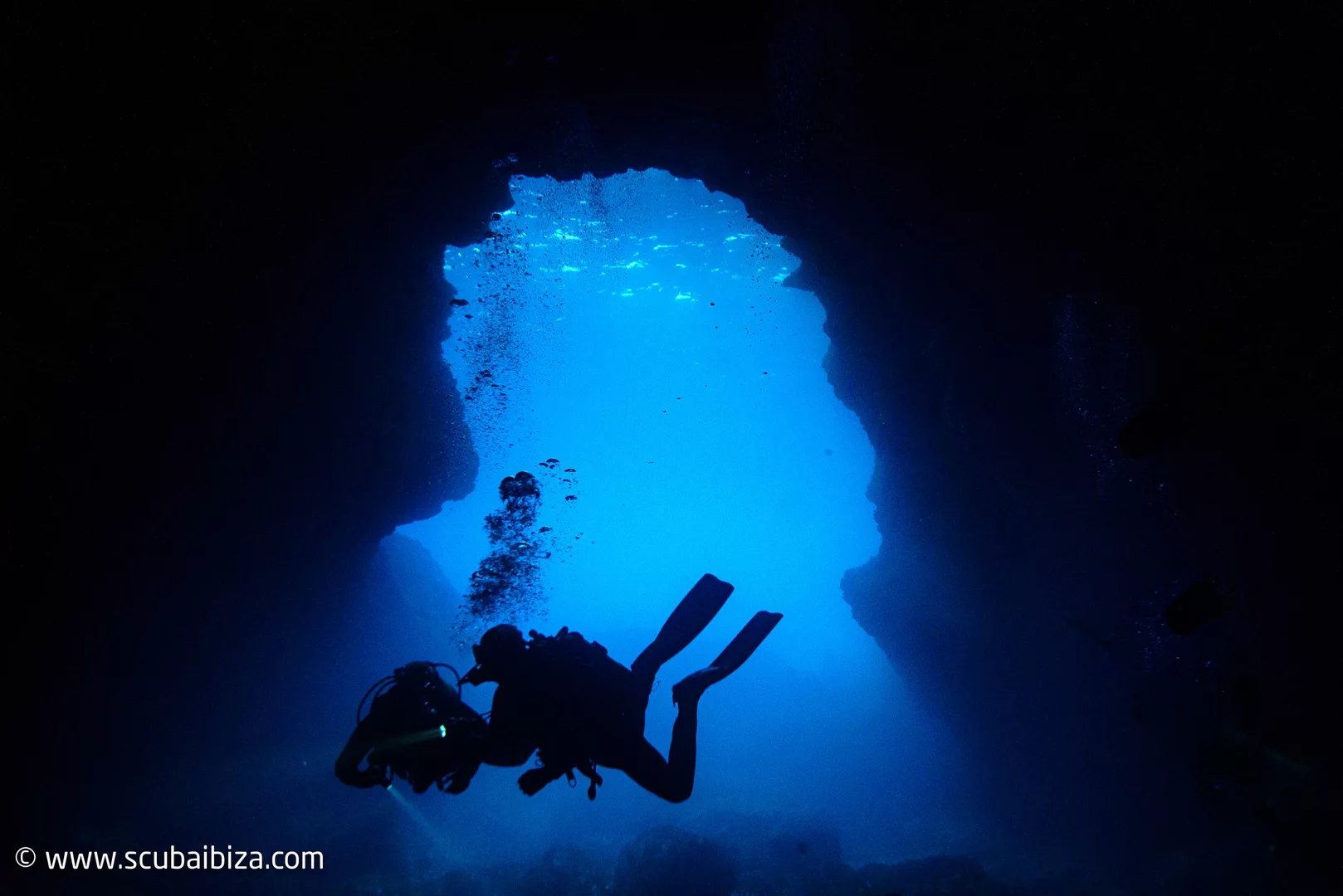
Some dive sites feel like underwater cathedrals. This one truly is.
La Catedral is where silence, light and stone come together in an unforgettable experience.

As you descend through the wide entrance, soft daylight guides you into an immense underwater chamber where towering rock walls create an atmosphere unlike anywhere else. A narrow passage leads to a second room known as The Chapel, where natural air pockets allow you to surface beneath the vaulted ceiling and admire the polished rock above. The shifting blue light transforms every moment into something almost surreal. Exploring this remarkable cavern with a torch reveals even more hidden beauty, but it should only be attempted within your level of training and experience. La Catedral isn’t just a dive—it’s an encounter with one of nature’s most breathtaking underwater masterpieces.

Photo By ScubaIbiza

Escalón Espartá

The island of s´Espartar is more than 2 km in length, a size which guarantees excellent opportunities for exploring underwater. Dive down off the island SE in the open parts there is plenty of bright green Posidonia, together with large examples of noble pen shells. You gain depth crossing these gentle Posidonia slopes, and after descending to 12 metres arrive at some formations of large rocks which drop vertically like steps down to 20 metres. There is then a narrow shelf, followed by a further drop taking you 40 metres below the surface, where the surface flattens to a sand bottom. In this dive you may can see barracudas, grouper, octopus, tune, moray eel, stonefish, small sea slugs (nudi-branchia), etc.

Spot Description by PADI

Photos by PADI

Agujeros Azules

What if the entrance to an underwater cave looked like a window into another world?

Descending into the crystal-clear waters of Portinatx, the first thing you notice is the light. At just 4 metres, natural openings in the rock create shimmering shafts that illuminate the cave below, turning the water into shades of blue and turquoise. Swimming deeper, the landscape unfolds through steps, passages and rock formations, with the famous “blue holes” glowing at around 9 metres. From there, the dive can continue down to 30 metres, offering something for every level of experience. With spectacular visibility and endless opportunities for dramatic light and shadow, it’s easy to understand why Agujeros Azules is a favourite among underwater photographers and videographers.

Photos by PADI

Los Chuchos

Los Chuchos, near Las Galletas, is a popular dive site for diving in Tenerife. Here you can find a wide variety of stingrays, also known by the Canarians as “chuchos”, as well as fish, moray eels and angel sharks among others. The site also offers views of small underwater caves.

Spot description by visitguiadeisora.es

Photos by  Miguel Miranda

El Peñon

“El Peñón” Tabaiba`s wreck

Tabaiba`s wreck is one of the best dives of Tenerife. It is a 35 meters long ship called ‘El Peñón’ is one of the favorite wrecks in the island. Its accessible from shore, there is a stair that goes straight to the wreck. Lost of fish schools like breams , barracudas as well octopuses and nudibranchs.

Spot description by Ana Ferreira

Photos by: Miguel Miranda

Montaña Amarilla

“Montaña Amarilla” is a very famous place in Tenerife. It is considered one of the best dive sites for both divers and tourists visiting the “Yellow Mountain.” Photographers come here to take beautiful photos during sunset. The dive is up to 20 meters deep. On the way, we swim through the rock arch. We dive along the underwater mountains to the cave. In those areas, we often see rays, eels living under the sand, and often an angel shark.Or  we dive shallower, up to 8 meters deep, along the volcanic reef to a place called the Dinosaur Cemetery. Rock formations look like dinosaur bones. On the way, we observe reef animals. We often see a turtle living here, and the entire way we are followed by fish that like to accompany divers.

Spot Description by divesite.es

Photos by: Ana Ferreira and Miguel Miranda