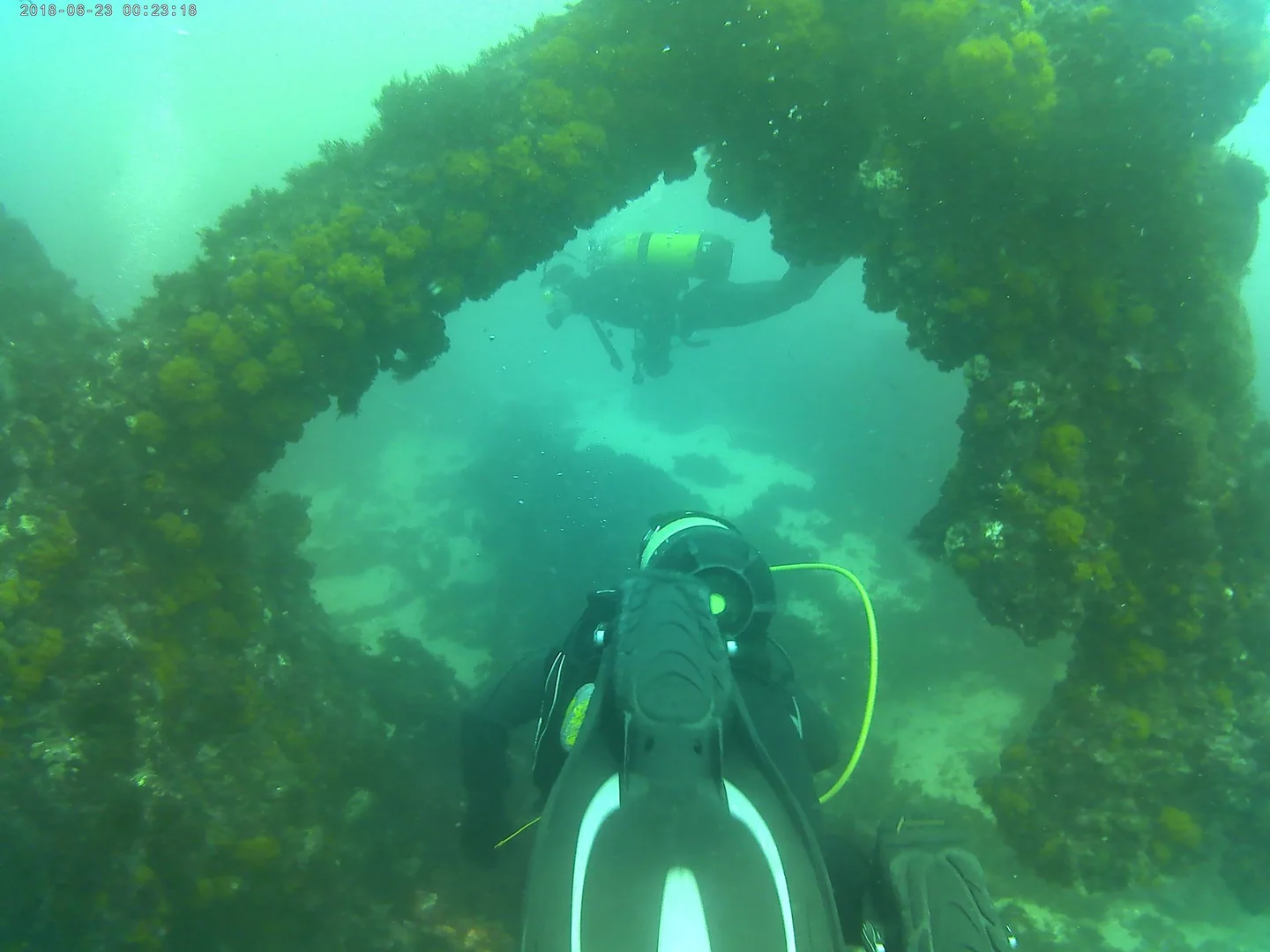
A deep, intense and beautiful dive located to the south of La Isla del Fraile and Cabo Cope, where we can find an average visibility of 15 metres. The anchorage is far from the coast, descending along the anchor.Large groupers, schools of croakers ( Corvinas ), nudibranchs, sunfish, as well as the damselfish, wrasses.
–Spot Description by : SSI
–Photos credits by: Ana Ferreira and Eurico Roseiro
On October 13, 1917, this ship met her fate, torpedoed and sunk by a German submarine just 10 kilometers east of Thomas Maestre Port along La Manga Strip. Originally called Thordisa, he later adopted the name Lilla. Dive deep into history as you explore the remains of the Italian steamship Lilla. Split in two near the engine room, this wreck offers swimmable passages, adorned with growth and vibrant marine life due to its long time beneath the waves. The engine room is home to large eels, common dentex and even the occasional sunfish surround the site. The ship’s name, “Lilla”, owes its origin to the cargo it carried – coal, known as “Carbonero” in Spanish. With a maximum depth of 45 meters and the deck at around 35 meters, this wreck delights a Nitrox diver, providing an extraordinary underwater adventure.
Diving point with a descent buoy located on the east side of the island of Tarifa. Anchorage depth is 15 meters. There is a possibility of drift diving. The best part of the wall is between 9 and 15 meters depth, schools of fish as wll small life like nudibranchs.
Wall dive with depth between 5 and 18 meters. Located between the San Andres buoy and Las Piscinas buoy. Possibility of travel in both directions and by the platform at the top.
Wall full of life, you can observe different types of soft coral, many types of sponges, nudibranchs, crustaceans, mollusks and moray eels hiding in the holes.
The San Andrés is a mid-19th century steamship wreck, it was built in England in 1853 and sank in the vicinity of the Island of Tarifa due to a collision with a freighter. You can see part of the deck and the two bushings on the sides of the blades that powered it. The ship has numerous holes full of life. It is easy to see groupers and conger eels here.Sometimes you can see sunfish de-worming at the cleaning station here. It is totally colonized by astroids.
The descent at this dive site is made without a reference buoy. The entrance is at the edge of the cliff of the island platform located between six and eight meters, right at the junction between the Atlantic Ocean and the Mediterranean Sea. The cliff goes down to 22 meters and from there to 40-50 meters.
You can see groupers, schools of corvina, lemon fish, barracudas, and lobsters.
The boquete is a hole in the wall of the island through which we can access the surface. It is located near the san andres buoy in a northerly direction at a depth of 6 metres, on the island’s platform. Inside the gap there is not much marine life, but we can see the contrasts of light passing through from the surface of the island. Be carefull not to enter on days with big waves .
Dive in the SW area of Tarifa. The descent is made by a buoy of the natural park of the straight. Depth between 16 and 30 meters. Wide diving area with different itineraries. Great diversity of marine life. Possibility to see different anchors of shipwrecks. Large schools of barracudas, also groupers.
Dive for all dive levels on the Atlantic side of the island of Tarifa with the possibility of access from the beach or by boat. Depth between O and 12m.Rocky and sandy bottom, ideal for buoyancy practices. Large shallow water area protected from the east wind. it is an ideal place for night dives.
This dive is on the Atlantic side of Tarifa Island. This is an easy dive site suitable for all levels. There is a wall area, sandy bottom, and rock corridors. The varied underwater configuration allows divers to make different routes between a depth of 8 and 18 meters.
The shape of the rocks gives the impression of walking through streets., we can observe numerous shrimp hidden among the rocks and sand, as well electric rays. You can see countless marine life in small holes, sometimes we can see harlequin rays.
This ship ran aground in the Bajos de los Cabezos. Her real name is El Cytos, but due to the large number of gorgonians she is better known as the ship of the Gorgonians. At present the Citus, “Ship of the Woods” or “Ship of the Gorgonians”, rests on a sandy bottom on its starboard side, at a depth of 32 m with its bow pointed to the southwest, its conservation being quite good. . Having been dynamited from its holds, we can distinguish two large areas: the bow and the stern, and between the two a large hole produced by the dynamite. The best time to visit the wreck are the months between August and March, since during the spring “La Almadraba” of Tarifa covers it in its entirety (being “La Almadraba” the traditional art of tuna fishing used on these coasts since Roman times).
We can observe gorgonians, conger eels, moray eels, spider crabs.