
Archives: Spots

Ajuy

Ajuy is a small town on the west coast of Fuerteventura. Access to this point must be from the beach, although we can descend to a depth of 15 m. This diving place depends a lot on weather conditions, so we only recommend visiting it on certain summer days. Now, carrying out this dive will allow us to contemplate a spectacular landscape. In which its waters contain large caves and other formations of volcanic stones. Rays and angelsharks are common and this site is only for expert divers.

— Spot Description by ifuerteventura.net

— Photos by Alain Monteiro and Alexandre Oliveira
Muelle de Morro Jable

The breakwaters of the pier provide shelter to numerous species such as black moray eels, groupers, old fish and seabream. During the mating season many angelsharks can be seen in the sandy area. It is a shallow place – it only reaches about 12 m -, so it is suitable for all levels.

— Spot description by: ifurteventura.net

— Photos by: Rolando Oliveira

Veril Pequeño

It is located to the west of Veril Grande and has similar characteristics to it, although it is less extensive and deep (15 to 30 m). Two types of dives are also possible here depending on the accredited level of the diver and their experience.

— Spot description by:  Ifuerteventura.net

— Photos by Pedro Afonso

Veril Grande

Located in Morro Jable, about 200 m from the beach, in front of the Punta del Matorral lighthouse. It is a stone wall whose upper part is 20 m deep and which falls vertically to about 40 m. In this spectacular enclave we can find a multitude of species such as black moray eels, sea bream, old fish, crabs, garden eels, bicudas, amberjacks, groupers, mutts and angelsharks. Sightings of large pelagics can also be made. The last one was a whale shark in August 2003. In this diving place you can do two types of dives depending on the accredited level of the diver and their experience.

— Spot Description by : ifuerteventura.net

— Photos by:

Las Setas

A mushroom-shaped volcanic rock, dramatic basalt walls and a drift dive full of surprises.

Named after a curious mushroom-shaped rock formation, this dive site is a fascinating showcase of Lanzarote’s volcanic underwater landscape. The adventure begins alongside a beautiful basalt wall, where striking rock formations create the perfect backdrop for a relaxed drift through the blue.

Let the current guide you along the wall as you explore its hidden corners. Keep your eyes open for angelsharks resting on the seabed, groupers watching from the rocks, and barracudas cruising past. You might even encounter a cuttlefish blending perfectly into its surroundings.

With depths between 10 and 19 metres, every moment offers another opportunity for discovery.

— Photos by Alexandre Oliveira and Nuno Almeida

Museo Atlántico

Imagine exploring an underwater world where art meets the ocean, and human figures become part of the marine landscape.

Located off Playa Blanca, this extraordinary underwater sculpture park was created by artist and diver Jason deCaires Taylor. Descend into the blue and wander among life-sized sculptures spread across the seabed, each installation telling a different story about humanity, society and our relationship with the ocean.

From the famous Human Whirlpool, with 200 figures forming a striking circle, to thought-provoking scenes of everyday life, every sculpture invites you to stop and look closer. Meanwhile, marine life gradually makes these artworks its home, blending art and nature into one fascinating experience.

At just 8–12 metres deep, this is a dive that inspires as much as it amazes.

— Photos by: introducinglanzarote and underwatermuseumlanzarote. com

Faro de Pechiguera

Ready to drift into the blue and discover what the Atlantic has hidden beneath the surface? Faro de Pechiguera is where the underwater landscape meets the excitement of the open ocean!

Just opposite the lighthouse, an enormous pyramid-shaped rock rises dramatically from the sandy seabed, stretching from 50 metres up to around 20. Its striking structure and the strong currents attract schools of fish and marine life moving through the Atlantic. As you drift along its slopes, keep your eyes on the blue — some of the most memorable encounters happen away from the reef, in the open water.

With an average depth of 20 metres and a maximum of 50, this dive rewards good planning and experience with a sense of adventure and the possibility of unexpected surprises.

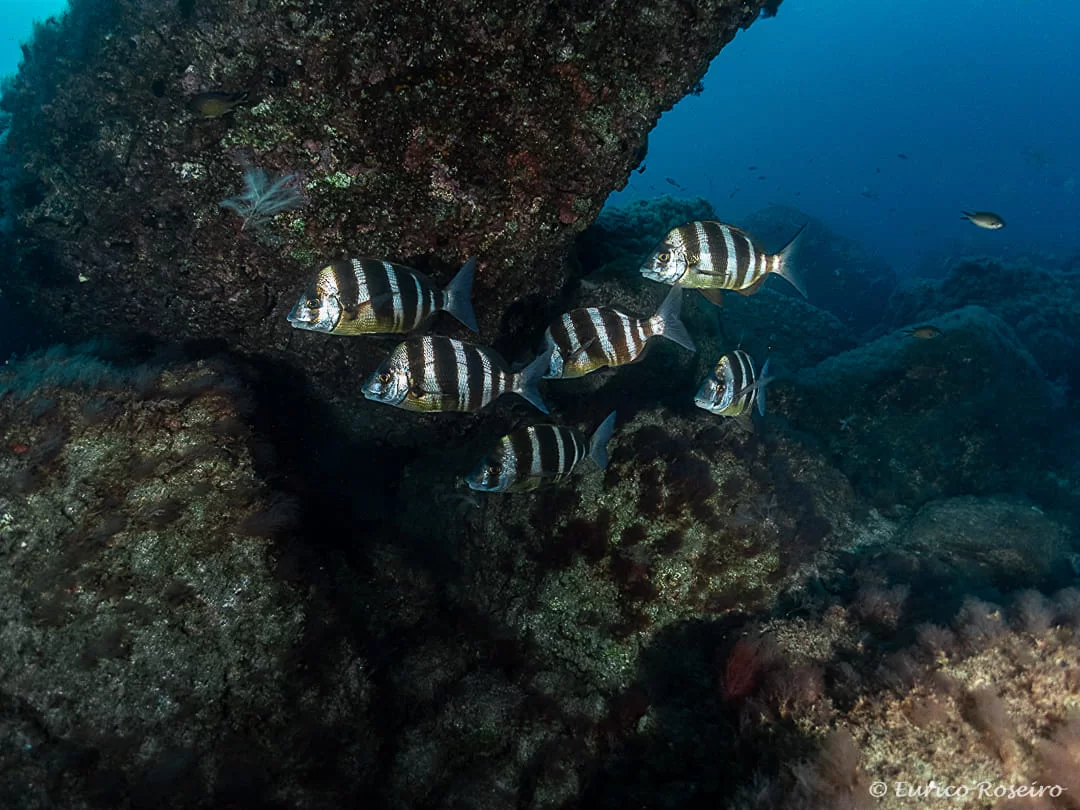
— Photos by: Ana Ferreira, Eurico Roseiro and Pedro Afonso

Punta Berrugo

Every nook and crevice has a secret waiting to be discovered. At Punta Berrugo, diving feels like a treasure hunt beneath the waves!

Following the small cliff where rock meets sand, you’ll find fascinating formations full of hidden corners to explore. Look closely and you may spot rays resting on the seabed, while schools of barracudas and samas move through the blue. Along the way, the scattered remains of an old wreck offer a glimpse into the past, slowly reclaimed by the ocean.

With most of the dive between 12 and 18 metres, there’s plenty of time to explore this underwater landscape at a relaxed pace. Choose your route, follow the reef and see what surprises you along the way.

— Photos by Miguel Miranda and Rolando Oliveira

Papagayo

Turquoise water, golden sand and a whole world waiting just beneath the surface. At Papagayo, paradise isn’t just something you admire from the shore — you can dive right into it!

Sheltered by a beautiful cove, this relaxed shore dive is perfect for slowing down and discovering Lanzarote’s underwater charm. Explore the rocky formations and watch the marine life going about its day: colourful parrotfish, curious ornate wrasses and fascinating spider crabs are just some of the creatures you might encounter.

With an average depth of just 5 metres and a maximum of 15, Papagayo is a wonderful spot for beginners and more experienced divers alike. Whether you’re snorkelling or scuba diving, there’s always something new to catch your eye.

— Photos by Ana Ferreira and Rolando Oliveira

Wrecks del Barranco del Quíquere

These three fishing boats are made out of wood and were built during the last century with the intention of taking to the oceans to steal fish from it; paradoxically, they have
ended their days at the bottom of the ocean, housing the creatures that were in times past its prey.
The two shallowest boats are found almost completely intact.
Contrary to this, the deepest one has a ghostly appearance, with its framing coming out of the keel like the ribs of a spinal column.

The turquoise blue of the water and the easy access invite you to wade in with masks and a snorkel. From the coast, you can descend from the cliff ladder by the shore, where the dive will begin. For diving with tanks, go in perpendicular to the shore until you reach the first two boats. It is preferable to leave the third wreck for boat access, due to the depth and distance it is at. This way we can explore the boats or stop to inspect the sand because angel sharks, manta ray and large stingrays hide there. Always pay attention to the dive computer because you could easily need a decompression stop.

— Spot Description by lanzaroteesd.com

— Photos by

Agujero Azul

This is one of the most famous dives in Puerto del Carmen, maybe because of the adventure factor that it offers. The Agujero Azul (Blue Hole) is a tunnel that connects the sandy shallow area to the cliff that descends into stunning depths.
Practically every animal can be seen on this dive, from sea horses all lined up at the bottom to angel sharks and large stingrays; some lucky divers may even encounter the majestic manta rays. Without a doubt, this is a dive that deserves to be repeated.

— Spot description by lanzaroteesd.com

— Photos by Alexandre Oliveira, Ana Ferreira and Eurico Roseiro


Cueva de las Gambas

The dive begins at the Playa Chica stairs or, if we go by boat, at the anchor buoy. From here, you can go down to the foot of the cliff, cross the field of gardener eels, and descend along the
impressive wall.
Under 25 – 30 m, the Atlantic damselfish give way to the fairy basslet and sea slugs which begin to appear. The sea slugs have an amazing shape and intense violet color. Upon arriving at the cave, enter carefully and draw close to one of the cavities where the narval shrimp take refuge. Within a few minutes, decompression will be necessary and you will need to begin your ascent, knowing that the shallow area offers us a perfect environment for making our security stop.

— Spot description by lanzaroteesd.com

— Photos by Ana Ferreira and Holaislascanarias