Archives: Spots

El Charco Azul

Charco Azul, a magical place as a result of the steepness of the coastline, the intense colours of the landscapes and the friendly transformation which human beings have been able to bring about.
The natural pools are of such beauty that when we arrived we almost wished we were going to swim in them rather than our underwater adventure.
On the right is the point of El Vardar, which is so called since, in the past, it was a place
of anchorage of watercraft which loaded and unloaded goods which were the fruit of the rich activity of this area. This is where we make our first dive with the intention of finding the anchors now attached to the bottom with the passing of the centuries.
On the left, following the coast under the Charco Azul, there is a curious landscape with small caves, cracks and cliffs which is well worth a visit and you can finish with a swim in the natural pool

— Spot description Guiadebuceolapalma
— Photos by Holaislascanarias

Puerto Espindola

Following the coastline of San Andrés y Sauces, you’ll discover an underwater landscape shaped by volcanic rock and filled with life. Colourful sponges and soft corals provide the backdrop as schools of amberjacks, abades, salemas, seabream and fulas move through the blue. Keep an eye on the sandy patches too — with a little luck, you might encounter a manta ray, an angel shark or other fascinating visitors.

With an average depth of just 5 metres and a maximum of 30, there’s plenty to explore. And when night falls, the seabed takes on a whole new personality, making a night dive an especially memorable experience.

— Photos by Bigfishtenerife

Dos Hermanas

Three rocky formations, two hidden tunnels and the chance of an unexpected turtle encounter.

Just off Los Guirres beach, near the Tazacorte harbour, these three volcanic rocks create an underwater playground for divers of different experience levels. Swim between the formations alongside schools of bastard grunts, explore the rocky landscape and keep your eyes open for turtles gliding through the blue.

The adventure continues at the largest rock, where two tunnels cut right through the formation. Venture deeper towards the sandy seabed and discover the underwater cliff and maze-like terrain stretching between 20 and 30 metres.

With a maximum depth of 30 metres, Dos Hermanas is full of little discoveries waiting around the next rock.

— Photos by Pedro Bernardo

La Salemera

Divers on the island have recommended that we should come to this remote spot that is
marked with a very picturesque lighthouse.
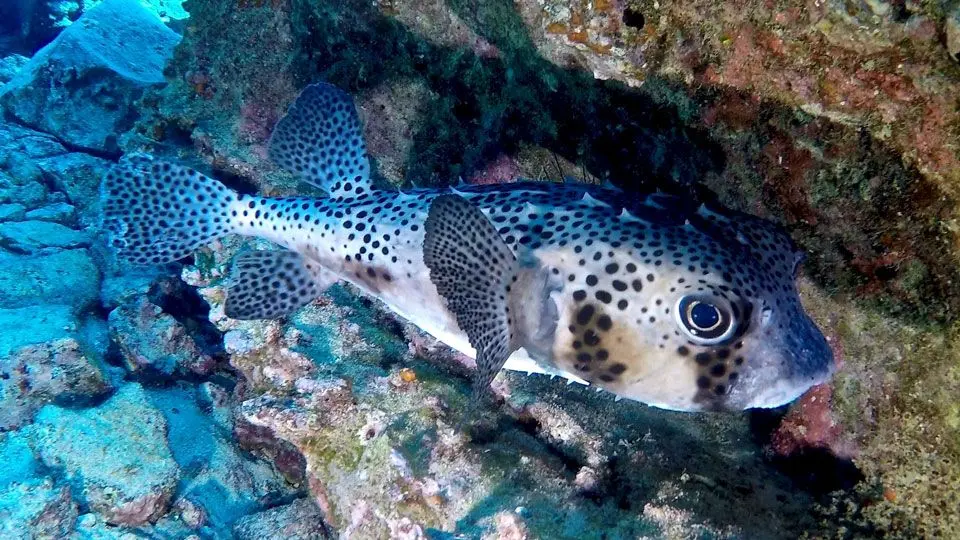
There are two different points separated from one another by 350 metres. Salemera south and north. In the south, you should follow the shelf while passing through a large anchor. In the north, under the reef where the waves break we lost count of the number of arches we saw and passed through. And going down to the depths, we passed over many lava tongues. As regards the fauna, we enjoyed seeing large spotted burrfish, stingrays, shoals of bicudas and even a hawksbill sea turtle which swam up to us very confidently.

— Spot description by Guiadebuceolapalma
— Photos by Rolando Oliveira

La Cueva del Diablo

This cave  is special for several reasons, on the one hand, the shapes inside it and, on the other, the final cavity where you can hold your head above the water and breathe. Although always taking special care with your flippers.
The naturalists of the expedition found “the cave within a cave” curious, the result of the rapid cooling of the lava and erosion by the sea. It is a kind of bubble with entrances and exits which, the first time you see it, you have to look at very carefully to understand how they are interconnected.
We can observe, Octopuses, Groupers, Manta rays, Moray eels, Spiny drum, Lobsters, Tuna.

— Spot description by Guiadebuceolapalma
— Photos by Holaislascanarias

El Pocito

This is one of those forgotten coves that we would not even have thought of diving in if we had not been told of the secrets it contains. Our approach through banana plantations, along a small track ending at the bottom of a quarry give this place an unusual atmosphere. To the north of the beach, the coast of solid rock is full of caves, passages and arches at very limited depths, making this dive an amazing place to explore. To the south, a large rock stands out in the bay, hiding an enormous arch and marking the way to a deeper dive. The sand is spread on the flat until it falls vertiginously to enormous depths, forming a canyon of sand that you can travel down as far as the black coral.
The brown garden eels watch over and cover the sandy hillsides forming a curious landscape.
On all the dives, we will see ornate wrasses near the seabed, usually in groups of females and juveniles, they are smaller and have more stripes. The largest specimens, are males and each one looks after his harem of females. At night, they completely disappear. We do not see them because they bury themselves in the sand or find holes in the rock to rest in.

— Spot description by Guiadebuceolapalma
— Photos by Vistacreate

La Bajita

A small cave, a large slope that goes into the blue and a tremendous sandy area dotted with enormous fingers of lava, full of color and where we can find schools of barracudas, salemas, sea bream and grunts. It is also usually inhabited by scrapies, mutts, mantelinas, sea eagles and even some angelsharks.
After entering the slipway with crystal clear waters, already full of small marine fauna, we will have two very different options. In the first, deeper dive, we will be able to contemplate the immense drop towards the blue and in the second, shallower, we will explore the rocky bottoms, full of life and we will understand why we are in an area of ​​​​small fishermen.
— Spot description by Guiadebuceolapalma
— Photos by Tuylapalma

Punta Resbaladera

This is another of the fantastic dives among nine which are available in the Marine Reserve. A perfect location to enjoy the contrast between diving in protected waters which are watched over where the sea life grows as it once could all over the archipelago. As we got ready for the dive, a group of dolphins approached the boat and spent time playing at the bow. It is a scene that is difficult to forget, which often occurs in the waters off La Palma.
We were so excited by this experience that we really wanted to get into the water. The effect of protection is clear because it was not difficult to spot groupers, barred hogfish, or even roakers, which are rare in unprotected waters. We were surprised by the size of all of them and especially the parrotfish.
When going down along the cable of the buoy to fourteen metres’ depth, we came upon a tongue of lava which arises from the land and runs into the sea. By swimming north, we came to a second tongue of lava the end of which makes up a very spectacular set of arches.
Without a doubt, this is one of the best dives in the Reserve. It was worth the effort and the time spent on board the boat to come here to get to know the secrets that are hidden here.

— Spot description by Guiadebuceolapalma
— Photos by Diving Graciosa

La Bombilla

Today, we have come to try our luck off La Bombilla. We have been told to get to the ledge to see about finding life in the sea, by diving to a small group of soft corals or even down to the black coral.
Following Today, we have come to try our luck off La Bombilla. We have been told to get to the ledge to see about finding life in the sea, by diving to a small group of soft corals or even down to the black coral.
Following the indications and the long tongues of lava it was easy to find the location.
A group of bicudas were patrolling the area while boga fish and sardines fled.
The shallowest part was adorned with a number of arches and tongues of lava of all kinds of shapes and sizes which served as a refuge for trumpet fish, Chilomycterus atringa, white sea bream and ornate wrasses. La Palma always surprises you with the shapes of its lava and each place has different sculptures that are well worth a visithe indications and the long tongues of lava it was easy to find the location.
A group of bicudas were patrolling the area while boga fish and sardines fled.
The shallowest part was adorned with a number of arches and tongues of lava of all kinds of shapes and sizes which served as a refuge for trumpet fish, Chilomycterus atringa, white sea bream and ornate wrasses. La Palma always surprises you with the shapes of its lava and each place has different sculptures that are well worth a visit.

— Spot description by Guiadebuceolapalma
— Photos by Holaislascanarias and Rolando Oliveira

El Hotel

A local diver told us that we would possibly see a conger eel on this dive. They are not very common at this latitude at diving depths so we decided to go looking for one.We descended the pronounced shelf which is below the hotel and we scrutinised the cracks, openings and small caves. We reached the black coral and entered the forest which was formed there. We were unlucky, it was not possible to find any conger eels. In view of our frustrating expedition, the diver who had spoken to us about a possible sighting offered to go with us and there the conger was at a depth of hardly twelve metres, hidden in its cave. Not only that, but on the surface we were able to see a hammerhead shark.
Access from the coast is an interesting option on this dive. The large parking area, located behind the beach, makes it possible to get your equipment to the water, with the result that you do not have to carry it so far. The lava flows indicate the route into the depths in the steeper areas and form labyrinths of stone in the upper parts. Remember to always be careful.

— Spot description by Guiadebuceolapalma
— Photos by wikipedia- Kris Mikael Krista

Puerto Naos “Playa Chica”

After a gentle descent to a depth of 12 meters we reach the edge of a wall that goes down to infinity. At the bottom we find sand, basalt rocks and lava formations. Due to the proximity of the marine reserve, it is one of the places with the greatest variety of underwater life on the island. We can find schools of sardines, breams, barracudas, trumpet fish and different types of moraeels. From a depth of 35 meters we can also admire the famous black corals. The place is recognized as one of the best for night dives.

— Spot description by Buceolapalma
— Photos by Holaislascanarias and Pedro Bernardo

Arcos de Charco Verde

This dive is just on the edge of the Marine Reserve, which means that it is enriched by the life forms generated there. One of the naturalists said that the large Chilomyctrus atringa that we came across was probably the largest he had ever seen. The parrotfish were also of a special size and we even saw an enormous grouper. It is probably preferable to go to see the arches by boat as they are at some distance from the beach. Judging by their arrangement, you would say that they must have been carved and deliberately placed to form a diving route. Apart from the arches, we were also struck by a large shoal of bicudas which practically swam ahead of us following the curious shapes of the rocks. This is ideal as a beginners’ dive or for a nighttime immersion. Starting from the coast, little by little, the size of the rocks increases and it is not difficult to get your bearings using the edge marked by the sand. Dives in darkness are always magical, the change of fauna which there is is so great and the transformation in their behaviour is so marked that it might seem that you are in a quite different sea.

— Spot description by Guiadebuceolapalma
— Photos by Holaislascanarias